


Home
>
The BotanicalDryGarden Blog
>
Dymondia margaretae: a lawn for small areas that keeps weeds at bay

Dymondia margaretae: a lawn for small areas that keeps weeds at bay
on Nov 14 2023
It stays low, grows slowly, but keeps weeds at bay. We are talking about Dymondia margaretae, one of our most distinctive low-water-use lawn varieties. It is a groundcover with an absolutely unique texture and colour, providing a discreet yet distinctive alternative to traditional lawn.
Thanks to its slow growth and low-growing habit, it is ideal for small areas that require very little maintenance while still preventing weeds from growing. The beauty of its silvery carpet and delicate yellow flowers does the rest, making it a lawn suitable for specific areas of the garden.
The characteristics of Dymondia margaretae
Dymondia margaretae is a groundcover composed of small, dense leaves that are grey-green on top and silvery underneath. From late spring through the whole of summer, it produces small yellow flowers. This variety thrives in full sun and requires well-drained soil, which makes all the difference to its performance. It is also particularly suitable for sandy soil and can grow on uneven and sloping ground.
It is the ideal lawn for those with little time to devote to garden maintenance, as it grows to a maximum height of 4 centimetres. Like other alternative lawn varieties, it tolerates dry spells very well and is also salt-tolerant, making it suitable for particularly hot climates and coastal areas. Furthermore, thanks to its ability to grow on rocky ground, Dymondia margaretae is also the ideal choice for anyone looking for a groundcover suitable for a Mediterranean rock garden.
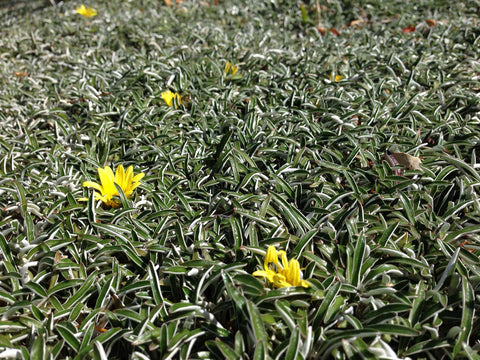
It is precisely its slow growth and tendency to stay low that make it a lawn that does very well on its own. When planted alongside other varieties, it would be overshadowed by more vigorous lawns. For this reason, it is recommended to reserve Dymondia for well-defined areas of the garden and small borders, giving it the time it needs to form its silvery carpet.
Planting and maintenance of Dymondia margaretae
For this variety, we recommend planting at least 10 plants per square metre. Dymondia takes a long time to cover the entire area, sometimes 12–24 months, which is much longer than other low-water-use varieties. However, the patience required will be rewarded by its ability to spread across all surfaces without being hindered by uneven, sandy, or rocky ground.
As with other alternative lawn varieties, planting should take place in autumn or spring. At the beginning of autumn, you can take advantage of the rainfall during the wet season, while planting in spring will require a little extra watering during the first summer to ensure the plants grow evenly.
To support them during the establishment phase, the lawn should be watered infrequently but with generous amounts of water. However, the watering frequency should be assessed independently based on the plants' needs, ensuring that the roots do not become too dry. Once the lawn has been established for a year, watering can be limited to once (or at most twice) a year, with substantial amounts of 20–25 millimetres. As for the maintenance of Dymondia margaretae, we recommend mowing 2 to 4 times a year, which is more useful for weed control than for lawn care, as it naturally stays low.
Dymondia margaretae is a distinctive lawn with unique characteristics that can meet the specific needs of coastal, rocky, or sandy gardens. To buy Dymondia margaretae and discover all its characteristics, visit our shop.
Share