


Frankenia laevis: a low-maintenance alternative lawn
on Oct 13 2023
A discreet ground cover that will cover the garden all year round. Many features make it resistant to almost everything. And a few peculiarities make it unique in its kind. Frankenia laevis is one of our most versatile alternatives to traditional lawns. Its versatility makes it suitable for full sun and partial shade, for coastal gardens, thanks to its excellent resistance to salt spray, and for winter landscapes, thanks to its good tolerance of very intense cold.
This drought-tolerant plant variety is perfect for those looking for a lawn that requires very little maintenance, as it reaches a maximum height of 4 centimetres. If saying goodbye to the lawnmower is not enough to make you choose it, here is a little peculiarity of this plant. Its dense emerald-green foliage is covered with pale pink flowers between May and June and, during winter, changes colour, turning its foliage red.
- The characteristics of Frankenia laevis
- Planting and maintenance of Frankenia laevis
- Low-water-use lawn combinations
The characteristics of Frankenia laevis
Frankenia laevis has numerous strengths, all due to its extreme adaptability. Among our alternative lawns, it is certainly the most versatile in terms of light exposure. It grows vigorously in all gardens, both those exposed to full sun and those covered by shaded areas.
Generally, we also recommend it for filling the gaps between the joints of paths and walkways: thanks to its growth, which always remains very low, it will be able to colour and fill all empty spaces without ever exceeding the paving. It is a plant with moderate resistance to trampling, suitable for filling the joints of walkways.
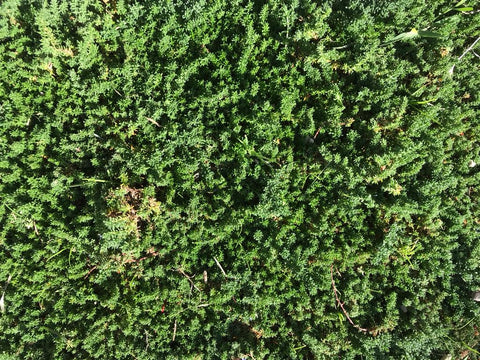
Its most important characteristic is certainly its cold resistance. Frankenia laevis is, in fact, one of our drought-tolerant lawns that adapts best to low temperatures. It is able to withstand down to -15°C, temperatures at which it will show its very peculiar colour. Although it is not an evergreen, it will not thin out in case of cold but will simply turn its tiny leaves reddish, giving a unique touch to your garden.
Planting and maintenance of Frankenia laevis
When should Frankenia laevis be planted?
Early autumn is, as with all our alternative lawns, the best time to plant Frankenia laevis. In its early life, all the young plants need a greater water supply to complete the establishment phase and cover the entire surface of the garden. By taking advantage of autumn rains, a smaller amount of irrigation can be used during this phase, but planting in spring is equally valid, provided that some extra irrigation is planned during the first summer. When planting Frankenia laevis, it is important to respect the planting density we recommend, namely at least 10 plants per square metre: this way, the lawn will close uniformly within 8/12 months.
When should Frankenia laevis be watered?
During the first year of Frankenia laevis's life, the lawn will need more watering until the establishment phase is complete. The watering should be infrequent but abundant, and the timing should be assessed based on soil moisture.
Once the lawn's first year of life has passed, watering can be limited to one (maximum two) very abundant watering per year. Thanks to its tendency to always remain very low, Frankenia maintenance does not require mowing, unless it is combined with other alternative lawns: in this case, 2 to 4 mowings per year will be enough.
Low-water-use lawn combinations with Frankenia laevis
As with the other varieties of our drought-tolerant plants, Frankenia laevis is particularly versatile in combinations with other alternative lawns. Combining different varieties not only enhances their characteristics but also makes the lawn more resistant and the soil richer. Here are our recommendations for the best combinations with Frankenia laevis.
Frankenia laevis + Achillea crithmifolia
Highly recommended mix, perfect especially for soils found in areas with a cold climate or for gardens with little sun exposure.
Frankenia laevis can also be combined with Verbena hybrida and Lippia nodiflora. However, these are much more vigorous plants than the low Frankenia, so they could overpower it if they find very favourable conditions for their growth. In these cases, it is a good idea to ask for personalised advice, thanks to which it will be possible to choose the perfect combination of alternative lawns for every need.
To buy Frankenia laevis and discover all its characteristics, visit our shop.
Share